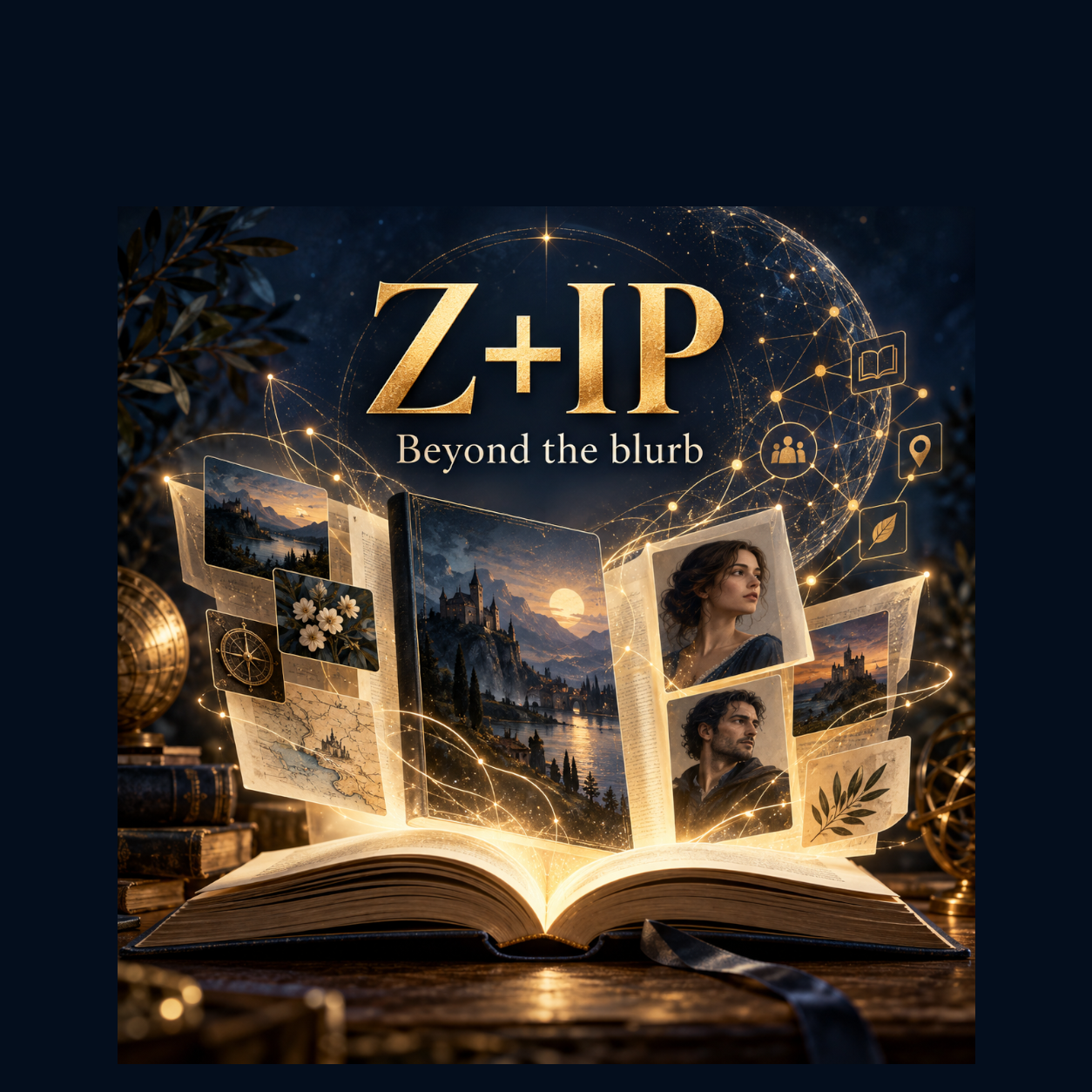
Z+IP
The book page beyond the blurb
Amazon’s A+ Content gave me an idea.
If you have browsed a book page on Amazon, you may have seen the extra images and text below the usual cover and description. They can introduce a series, show its setting or give a reader a closer look at its characters. I liked the principle: a book can have more to say for itself than a cover and a blurb.
But those pages belong to Amazon. I wanted to bring that same sense of discovery to my own websites, where readers could learn about a book before deciding where to get it. That became Z+IP, my shorthand for an A+-style information page.
A Z+IP page begins with a banner that sets the mood. Below it, 300×300 image tiles draw attention to aspects of the story: perhaps a place, a moment of danger or a question at its heart. Some books call for character introductions. Others benefit from a note about the author or an explanation of where they fit in a series. The blurb still has a job to do, but it no longer has to do every job on its own.
The structure changes with the book. A wartime story, a science fiction novel and a noir novella should each feel like themselves. The point is to give readers useful ways into the story, without explaining away the surprises.
Then there are the nuts and bolts the reader cannot see.
Each page has a clear title and description, but I also add JSON-LD structured data. This is a small piece of code that tells a search engine what the page is about in a format it can read directly.
JSON-LD stands for JavaScript Object Notation for Linked Data. You can find samples online at https://schema.org/Book
On a book page, it can identify the work as a book and set out details such as its title, author, cover and available offers. In effect, the page speaks to two visitors: the reader who sees the words and images, and the Google crawler that reads the page’s code.
The code must agree with what the reader can actually see. It cannot turn a vague page into a useful one, guarantee that Google will index it or promise a better position in search results. But it gives Google a clearer account of the book and the page we have built around it. I validate the code and submit the finished page for indexing, then watch what happens over time.
I started Z+IP because I wanted my book pages to do more. A reader might first spot a book on social media, hear about it from a friend or find it through a search. If they land on my website, I want them to find more than a sales button. I want them to get a feel for the story and decide whether it is for them.
Amazon’s A+ Content supplied the spark. Z+IP brings the idea onto my own websites: a page shaped around the book, useful to the reader and clear enough for a search engine to understand.
You can see a real-live Z+IP page in action by clicking the link - https://www.fictionbooks.online/walking-away-from-midnight/
Copyright © Brittle Media Ltd 2026