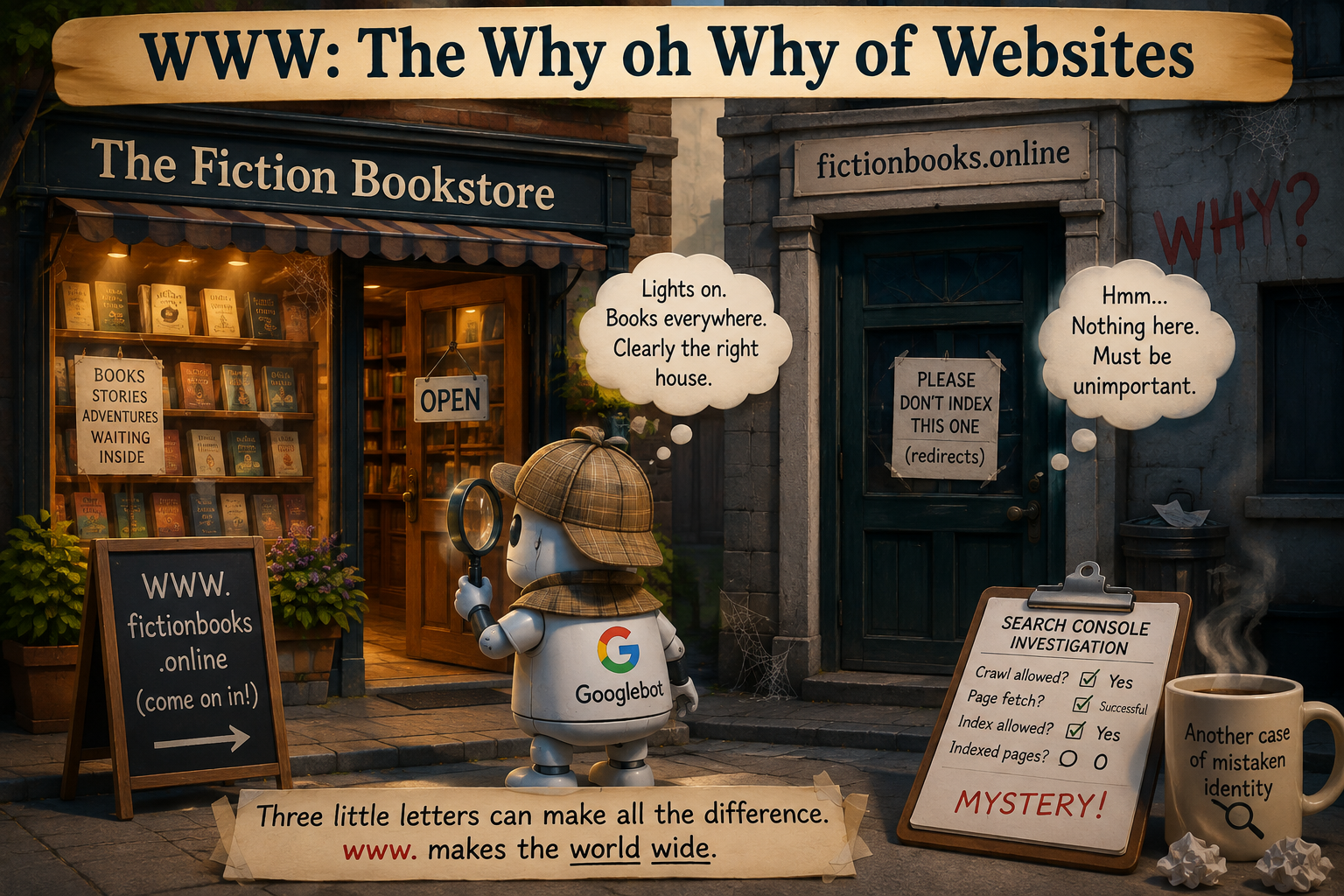
WWW: The Why oh Why of Websites
The Great Google WWW Mystery
There are mornings when running an online bookstore feels remarkably like running an actual bookshop.
You open the doors. You straighten the shelves. You check whether anybody came in yesterday. You make sure the till still works.
Then you discover Google has been standing outside the wrong building for several months.
Welcome to WWW: The Why oh Why of Websites.
It began with a simple question.
According to Google Analytics, The Fiction Bookstore had recorded 245 page views over the previous 28 days.
Excellent.
According to Google Search Console, the website had managed eight impressions.
Less excellent.
Even allowing for the fact that Google Analytics and Search Console measure different things, eight versus 245 seemed a little extreme.
So I investigated.
Search Console informed me that 29 pages weren't indexed.
Fair enough. Websites accumulate rubbish. Old pages disappear. Links change. In my case, Fiction Books Online had undergone a fairly substantial transformation, moving from WordPress to an IONOS website and, more recently, becoming The Fiction Bookstore.
Then came the interesting number.
Indexed pages: 0.
Not one.
Apparently, as far as Google Search was concerned, The Fiction Bookstore contained fewer searchable pages than my garden shed.
This was particularly impressive considering the shop contains dozens of books, series pages, a help section, a blog and enough material to keep an enthusiastic reader occupied for quite some time.
Search Console had other ideas.
So my AI accomplice Sam and I started investigating.
Googlebot, it turned out, had visited.
It could access the website.
Crawl allowed? Yes.
It could retrieve the website.
Page fetch? Successful.
Was Google allowed to index it?
Yes.
Wonderful.
So why wasn't it indexed?
Then we found the body.
Or, more accurately, three little letters.
www
Search Console had been set up to monitor:
fictionbooks.online
But the website itself regarded its proper, canonical address as:
Google agreed.
When asked to inspect the WWW version, Search Console effectively replied:
"Never heard of it. Doesn't live here."
When asked about the version without WWW, it happily explained that it wasn't indexing it because it redirected to the WWW version.
In other words, Google had been carefully monitoring the address it had already been instructed not to index.
IONOS, meanwhile, had previously checked the website and declared everything fine.
And, annoyingly, IONOS was right.
The website was fine.
Google was right too.
It was correctly following the redirect.
Search Console was also technically right.
It was faithfully reporting information about the property it had been asked to monitor.
Everybody was right.
And the whole thing was wrong.
The solution took about five minutes.
I created a new Search Console Domain property for fictionbooks.online rather than one particular version of its address. Google sent me to IONOS, I authorised the connection, ownership was verified, and suddenly Google was permitted to acknowledge the existence of both versions of the same website.
It is now "processing data".
I imagine somewhere inside Google a very small robot has just looked up from its clipboard and said:
"Ah. You meant THAT bookstore."
There is a lesson here for anyone running their own website.
Don't assume that because Google Analytics is collecting data, Google Search Console understands your website.
Don't assume that because your hosting company says everything is working, every Google service is looking at the right version.
And, most importantly, never underestimate the power of three apparently insignificant letters.
WWW.
Without them, Google and IONOS would make rather poor burglars.
They'd spend months watching the wrong house, carefully record that nobody appeared to live there, and eventually produce a detailed report explaining that the house next door didn't exist.
Meanwhile, inside The Fiction Bookstore, the lights are on, the shelves are full and the proprietor is having another cup of coffee.
Mystery solved.
Probably.
This is Google, after all.
Copyright © Tom Kane 2026