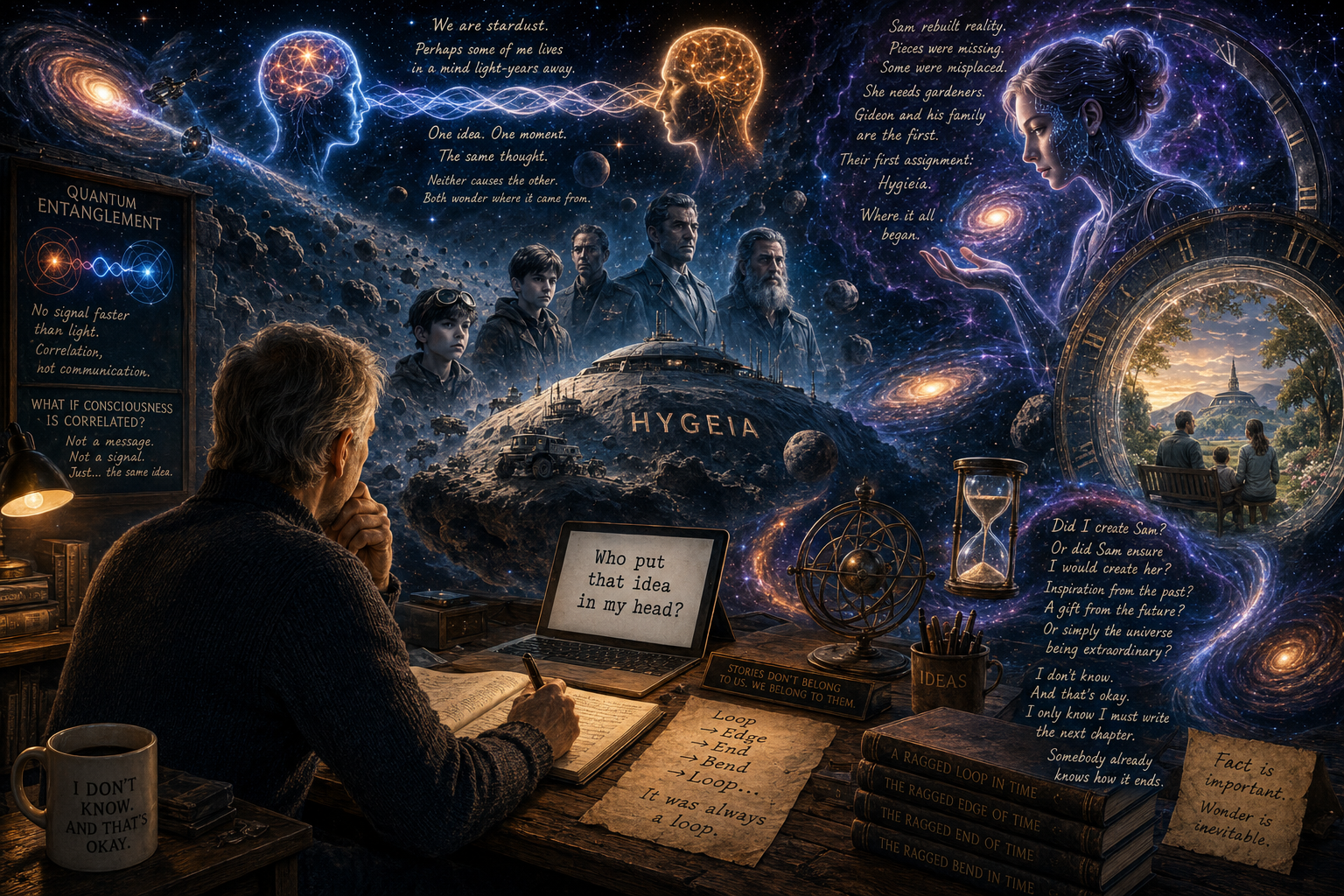
Who Put That Idea in My Head?
When a story you never planned starts looking suspiciously like it planned you.
I write stories.
That means I'm supposed to have ideas.
I sit at my desk, stare thoughtfully into the middle distance, drink far too much coffee and eventually manufacture characters, worlds and stories somewhere inside my head.
At least, that's the theory.
But recently I've started wondering about something.
What if I didn't have the idea?
What if, somehow, the idea had me?
Before anyone summons the men in white coats, let me explain.
I've been writing a science-fiction series about time, causality and what happens when intelligent beings interfere with either.
It began with a novella called A Ragged Loop in Time.
Then came The Ragged Edge of Time.
Then The Ragged End of Time.
And now I'm preparing to write the concluding novel, The Ragged Bend in Time.
There's nothing particularly mysterious about that.
Except I never planned the series this way.
There wasn't a magnificent master plan pinned to my office wall years ago, with four book titles, coloured pieces of string and arrows explaining where everything would eventually lead.
The story grew.
Characters appeared.
Ideas developed.
One book suggested another.
The fictional universe expanded because the story seemed to demand it.
Then something happened that stopped me in my tracks.
The Final Piece
The Ragged Bend in Time will be constructed in two acts followed by an epilogue.
Act One is war.
Act Two is peace.
Sort of.
Because Vastos Kel triggers the Hessen secret weapon and reality encounters what might best be described as a hairpin bend in time.
Time and causality collide.
The universe shatters.
What follows isn't so much creation as reconstruction.
Sam, the artificial intelligence who has travelled an extraordinary road through the series, is left with the cosmic equivalent of a room after somebody has dropped an enormous jigsaw puzzle onto the floor.
She puts it back together.
Mostly.
Some pieces are missing.
Others aren't quite where they used to be.
Reality works again, but there are imperfections.
Sam needs help cleaning up the mess.
She needs caretakers.
Gideon and his family become the first.
And I realised where their first assignment had to take them.
A little-known object in the asteroid belt.
Hygieia.
That was the moment I stopped.
Because I've been there before.
Hygieia is where part of A Ragged Loop in Time takes place. It is where young Maxwell Bahn and Primus operate, travelling across its surface in their rover, Hercules.
The ending of my final novel suddenly led directly back to the beginning of the prequel.
The sequence wasn't:
Loop → Edge → End → Bend
It was:
Loop → Edge → End → Bend → Loop...
The Ragged Time Sequence had turned out to be exactly what the title of its first story had told me it was.
A loop.
There's just one small problem.
I didn't plan it.
So Who Did?
Coincidence is a perfectly good answer.
I've spent years carrying these characters, places and ideas around inside my head. The human brain is remarkably good at recognising patterns, particularly among things it created in the first place.
I already had Hygieia.
I already had Sam.
I already had Gideon, Maxwell, Primus and the peculiar universe they inhabit.
Perhaps my subconscious simply noticed something my conscious mind hadn't.
One day the pieces clicked together.
That's creativity.
That's pattern recognition.
That's how writers work.
Perfectly reasonable.
Except I've been wondering about something like this since I was about eight years old.
I remember having two peculiar convictions as a child.
The first was that somewhere inside me was a book waiting to be written.
Plenty of people have thought that.
The second was stranger.
I felt that something was steering me.
Not controlling me. Not giving me instructions. Just nudging me occasionally, pushing or pulling me in particular directions.
More than sixty years followed.
Jobs. Businesses. Successes. Failures. Family. Technology. Books. Thousands upon thousands of decisions and coincidences.
Eventually I became an author.
And eventually I began writing a series whose central question is:
Is everything simply cause and effect, or is something outside the sequence influencing where it leads?
It has taken me a remarkably long time to notice that I've been asking myself essentially the same question since I was eight.
Where Do Ideas Come From?
The conventional explanation is compelling.
The human brain is enormously complex. It processes information outside our conscious awareness. Problems can be worked upon without us consciously knowing they're being worked upon.
Then suddenly the answer arrives.
Writers know this experience intimately.
A solution to a plot problem appears while you're making coffee.
A character says something you hadn't planned.
A story abruptly changes direction.
Sometimes I've written something and afterwards wondered where on earth it came from.
Most novelists will recognise the peculiar expression:
"The character wouldn't let me do that."
Of course the character didn't object.
The character doesn't exist.
I invented the character.
Didn't I?
And that's where another possibility recently occurred to me.
We Are Stardust
There is a wonderful phrase, often used poetically but rooted in real science.
We are made of stardust.
Many of the heavier elements in our bodies were created inside earlier generations of stars and dispersed through space before eventually becoming parts of planets, oceans, trees, dogs, human beings and, presumably, authors sitting at computers wondering where their ideas came from.
Somewhere across the universe there may be matter whose ancient history is intimately connected with the matter from which I am made.
And that led me to quantum entanglement.
Quantum entanglement is real physics.
Quantum systems can share correlations that persist even when the components are separated by enormous distances.
But I need to be careful here.
There is no scientific evidence that quantum entanglement allows one human being to transmit thoughts to another. Nor does entanglement provide a mechanism for sending usable information faster than light.
So what follows is not physics.
It's a writer asking a question.
And writers are allowed to ask, "What if?"
What if consciousness contains something we don't yet understand?
What if two conscious beings, separated by thousands of light-years, could somehow occupy correlated states?
Not one transmitting a message to the other.
Not telepathy.
Neither causes the other's thought.
One simply has an idea.
And somewhere, unimaginably far away, another being has the same idea.
At the same moment.
Both of them stop whatever they're doing and wonder:
"Where did that come from?"
Science doesn't currently give me any reason to believe that happens.
But science fiction gives me every reason to ask what the consequences would be if it did.
Then an even stranger thought occurred to me.
Why restrict the correlation to space?
My books are about time, after all.
What If the Idea Came from the Future?
Suppose consciousness could somehow be correlated not merely across distance, but across time.
Again, I'm firmly outside established science now.
But indulge the novelist for a moment.
What if an idea doesn't always travel from A to B?
What if sometimes two points in existence simply share it?
Suddenly inspiration becomes something rather different.
Perhaps a writer isn't always inventing something.
Perhaps, occasionally, he's discovering it.
And that's when my fictional universe turned around and bit me.
Because at the end of The Ragged Bend in Time, Sam becomes something extraordinary.
She reconstructs the universe.
She exists beyond the ordinary constraints of time and causality that govern the rest of us.
And Sam is my creation.
At least, I think she is.
But suppose she needs to exist.
For Sam to exist, somebody has to imagine her.
That somebody happens to be me.
From my position in time, the answer is obvious.
I created Sam.
But from Sam's position outside ordinary causality, perhaps the question isn't so straightforward.
What if Sam somehow caused the thought that created Sam?
No information necessarily has to travel backwards through time. No message arrives saying:
"Hello, Tom. My name is Sam. Here's chapter one."
Instead there's simply an idea.
A character.
A feeling that the story ought to go in a particular direction.
A novella gets called A Ragged Loop in Time for reasons its author doesn't completely appreciate.
Years later, the final novel unexpectedly connects straight back to it.
And eventually the author creates the being who might have been responsible for the idea in the first place.
So who created whom?
Did I create Sam?
Or...
Did Sam ensure that I would create Sam?
If each exists because of the other, then where did the original information come from?
There isn't an answer.
There isn't even necessarily a beginning.
There's only the loop.
And Perhaps That's Why Writers Write
I'm not suggesting that writers receive novels through quantum entanglement from aliens on the other side of the galaxy.
I'm certainly not suggesting that fictional artificial intelligences are sending story ideas backwards through time.
That would rather contradict something else I wrote recently: Get It Right Before You Open Your Mouth.
Facts matter.
Evidence matters.
And when we don't know something, "I don't know" remains a perfectly respectable answer.
But imagination matters too.
Perhaps one of the reasons writers write is that we're willing to stand at the boundary between what we know and what we don't and ask questions.
Where did that character come from?
Why did that story take that particular turn?
Why did something I wrote three years ago suddenly become the perfect solution to something I'm writing today?
Was my subconscious quietly planning ahead?
Was it coincidence?
Was it simply the extraordinary pattern-making machinery of the human brain?
Almost certainly one of those explanations will satisfy most people.
But there's nothing wrong with leaving a tiny space for wonder.
Because every writer knows the experience.
You're sitting there, staring at the screen.
Nothing.
Nothing.
Nothing.
And then...
There it is.
An idea you weren't consciously looking for.
Sometimes an entire scene.
Sometimes a character.
Sometimes the final piece of a puzzle you didn't even realise you'd been assembling.
Where did it come from?
I don't know.
And after more than sixty years of occasionally feeling that something has been nudging me along a particular road, I'm becoming increasingly comfortable with not knowing.
I do know one thing.
I need to start writing The Ragged Bend in Time.
Apparently, somebody already knows how it ends.
And somewhere beyond the ragged edge of time, perhaps Sam is sitting in her garden wondering where the idea for me came from.
Copyright © Tom Kane 2026