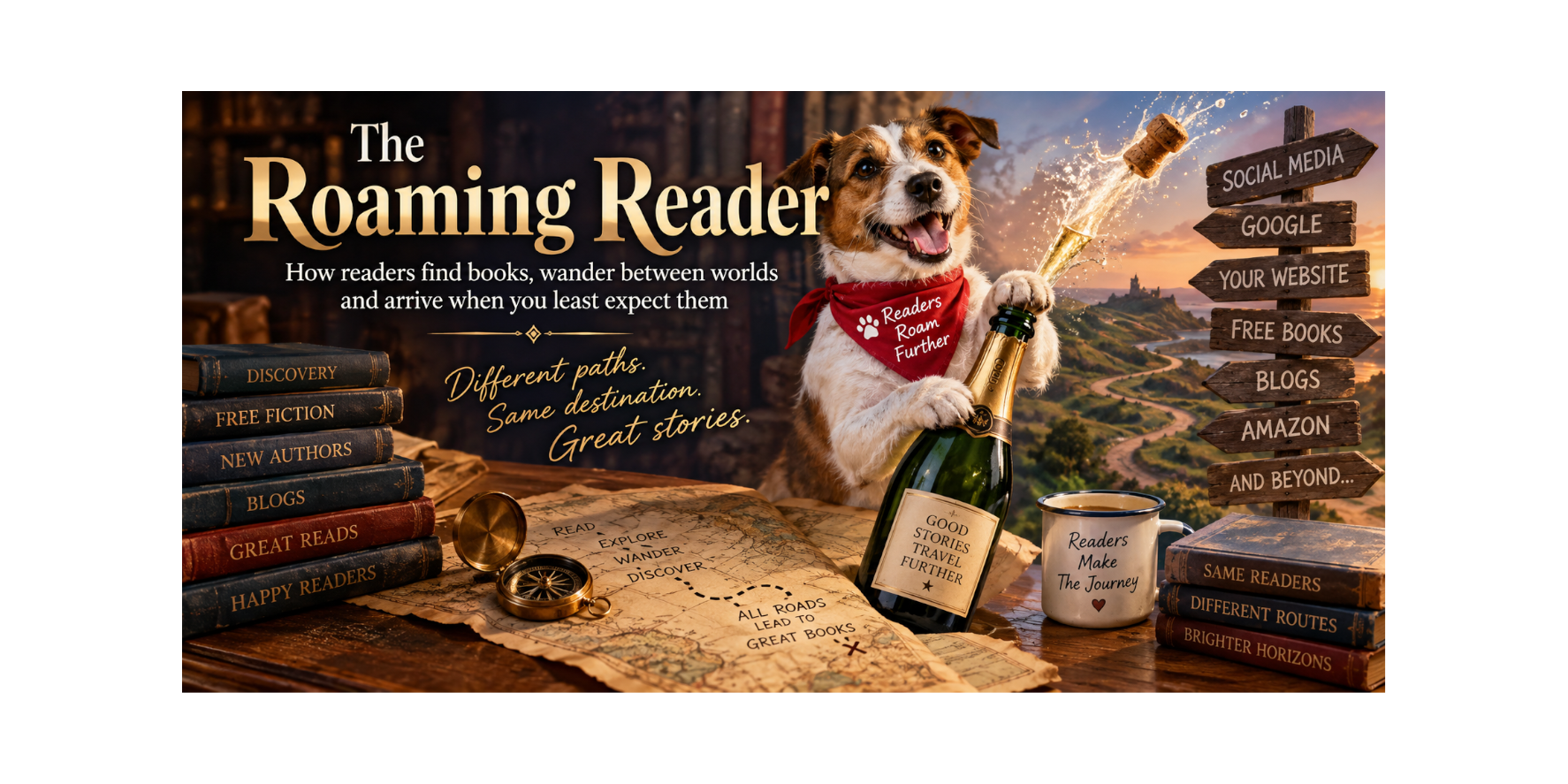
The Roaming Reader
For years, independent authors have been taught to think in terms of funnels.
A reader sees an advertisement. They click the advertisement. They arrive on the book page. They buy the book.
Nice. Neat. Measurable.
And, increasingly, I suspect, wrong.
Or at least only part of the story.
A few days ago, I ran a small experiment. I advertised one of my books across several social-media platforms, using separate trackable links for each. The theory was simple enough: I would see which platform produced the clicks and, hopefully, which clicks eventually produced sales.
There was only one slight problem.
Almost nobody clicked.
But books sold anyway.
That started me wondering whether I had been looking at book discovery from the wrong direction.
Readers don't necessarily follow a map
Imagine somebody sees a book mentioned on Facebook.
They don't click it.
Later that evening they remember the title, or perhaps just the author's name. They search Google. They find the author's website. They look at another book. Then they disappear.
Two days later they encounter the author again on Amazon.
This time they download a free book.
They enjoy it.
A week later they buy another.
Which advertisement sold the book?
Facebook?
Google?
The author's website?
Amazon?
The free book?
The answer may be all of them.
The reader didn't follow a funnel.
They roamed.
And now I'm beginning to see them
This was merely a theory until I started bringing together information from Google Analytics and Google Search Console across my websites.
One of those sites is https://geni.us/FictionBooksOnline and it has recorded 3,237 page views from 1,002 active users so far this year. Those visitors average 3.23 page views each.
Some of the individual figures are even more intriguing. The e-book series section has averaged 7.44 views per active user, while the blog has recorded 10 views per active user.
That doesn't look like everyone arriving, glancing at one book and leaving.
Some people are wandering around.
Or, as I now prefer to call it, roaming.
Then Google joined the experiment
Another of my websites is https://getbook.at/FreeFictionOnline
Its purpose is exactly what the name suggests: somewhere readers can find fiction they can read for free.
Google Search Console is now beginning to tell me how people discover it.
So far, Google has recorded 925 search impressions and 14 organic clicks, with an overall average search position of 17.75.
Those aren't enormous numbers.
They aren't supposed to be. This isn't a story about thousands of visitors suddenly descending upon a website.
It's about what those first few visitors might be telling us.
Because one search phrase in particular caught my attention:
"free fiction".
FreeFiction.online has appeared 36 times for that generic search, producing three clicks, an 8.33% click-through rate, at an average position of 21.92.
That's very different from somebody searching specifically for me or one of my books.
Somebody went to Google looking for free fiction. Now let me put this in perspective. Amazon will give you over 20,000 results for "free fiction" If you search for 'free fiction' on Google, can expect several hundred million results. Each SERP (Search Engine Results Page) will have around 10 results. I have no idea where my website comes in all that, but Google still showed them my website.
And some of them came in.
Where did they go afterwards?
That's the interesting question.
The journey we don't see
Perhaps our obsession with clicks has encouraged us to assume that readers behave logically.
Readers, however, are human beings.
I know from my own behaviour that I can discover something on one device and buy it several days later on another. I might see something mentioned on social media, search for it independently, read about it elsewhere, forget about it, encounter it again and finally make a decision.
Attribution software desperately wants to draw a straight line through all that.
Human beings stubbornly refuse to walk in straight lines.
And books may be particularly susceptible to this behaviour.
A book isn't usually an urgent purchase. Nobody wakes at three in the morning shouting, "Good God! I forgot to buy that historical novel!"
Discovery can therefore happen long before purchase.
The important event may not be the final click.
It may have been the third or fourth encounter with the author.
The indie author's ecosystem
This has changed how I'm beginning to think about my own websites, retailers and social media.
Amazon isn't necessarily competing with my direct bookstore.
My direct bookstore isn't necessarily competing with my free-fiction website.
My blog isn't necessarily competing with my book pages.
Facebook, BlueSky, X, Instagram and Threads don't necessarily have to produce an immediate click to have done something useful.
Neither does Google.
They may all simply be different places where a reader encounters the same collection of books.
The reader might enter through one door and eventually buy through another.
For an independent author, perhaps the objective shouldn't always be:
Get the reader from A to B.
Perhaps it should sometimes be:
Make sure the reader keeps bumping into you wherever they happen to roam.
All roads lead somewhere
I'm still gathering the data.
It is far too early to declare that I've proved anything. Search Console is only beginning to reveal how Google sees my sites, and Analytics can tell me what happens on my websites but not everything a reader subsequently does elsewhere.
There are enormous gaps between discovery and purchase that I may never be able to fill.
But perhaps that's the point.
We've spent years trying to force readers into funnels because funnels are convenient for marketers to measure.
Readers weren't consulted.
My suspicion is that many of them have been cheerfully wandering off the prescribed route all along.
So I'm going to continue watching.
No frantic website alterations.
No changing things because Tuesday's graph looks different from Monday's.
And, most difficult of all for an independent author...
No fiddling.
I'm going to let the websites, search engines, retailers, free books, blogs and social media do their respective jobs and see whether a recognisable pattern emerges.
Because there may be another kind of reader out there.
Not the reader waiting obediently at the bottom of a marketing funnel.
The reader who sees a book here, an author there, reads a free story somewhere else, searches Google next Tuesday and buys something from Amazon on Friday.
The Roaming Reader.
And I have a feeling we've been selling books to them for years without realising they were there.
Copyright © Brittle Media Ltd 2026