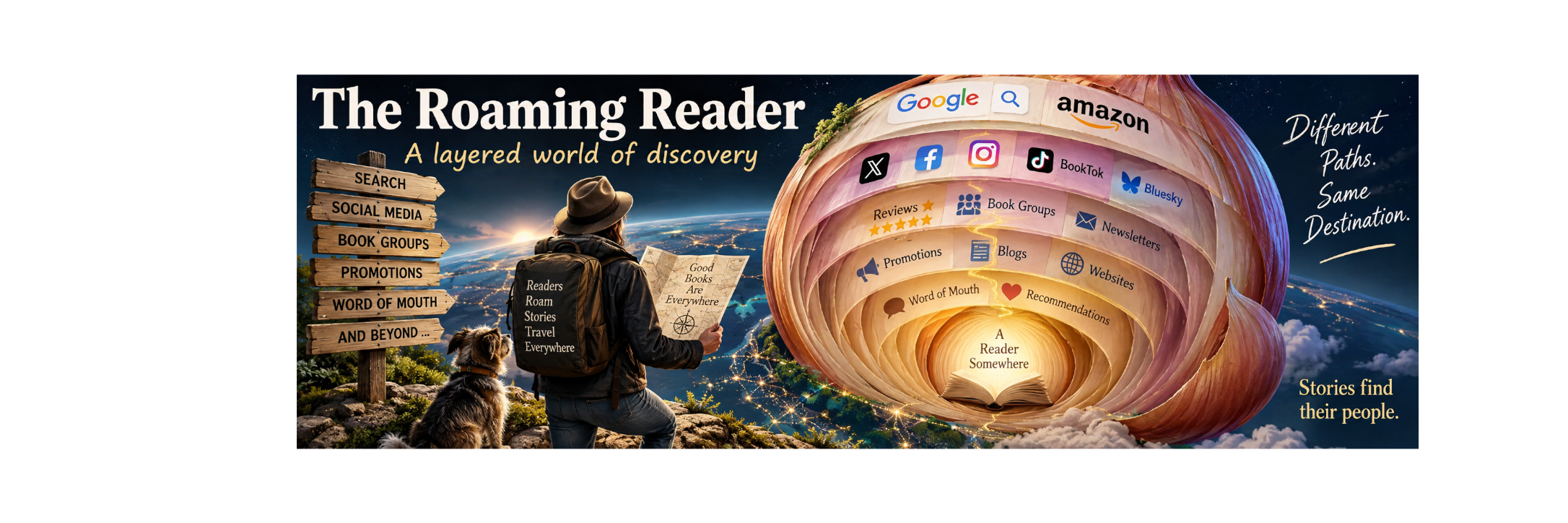
Interaction, Algorithms and the Roaming Reader
Interaction is the stuff of legends for indie authors.
In the early days of Kindle, a fortunate few discovered that visibility could become a rather wonderful circle. A book sold, the retailer noticed, the book became more visible, more readers discovered it, more copies sold and around the circle it went.
Those days haven't entirely disappeared.
But the circle has become an awful lot bigger.
The Great Interaction Myth
Spend any time among indie authors on social media and you'll encounter a familiar worry.
"My posts aren't getting any interaction."
Or:
"I've got thousands of followers, but nobody is buying my books."
The understandable conclusion is that something has gone wrong.
But has it?
We have become accustomed to measuring social media by the things the platforms allow us to see: likes, reposts, comments, shares, impressions and clicks.
The trouble is that none of those things is a book sale.
A reader can see your post and do absolutely nothing.
No like.
No repost.
No comment.
No click.
And then buy your book three days later.
From Amazon.
How do you measure that?
Mostly, you don't.
Interaction Still Matters
This doesn't mean interaction is worthless. Far from it.
Interaction can help social-media platforms decide whether something is interesting enough to show to more people. The exact mechanisms vary between platforms and change constantly, but engagement, relevance and people's behaviour around a post can all contribute to its distribution.
It also means that being present matters.
Not necessarily shouting "BUY MY BOOK!" every morning before breakfast, but producing interesting material consistently enough that people occasionally notice you.
A comment here.
A photograph there.
A piece about writing.
An extract from a new novel.
A conversation with another author.
A strange thought that occurred to you at three o'clock in the morning while writing Chapter Twenty-Seven.
That's interaction.
And sometimes the most important person interacting with your content doesn't interact with it at all.
They simply see it.
Meet the Invisible Reader
This is where I think indie authors sometimes misunderstand reader interaction.
We assume interaction means an action we can measure.
It doesn't.
A reader might see the cover of your novel on Facebook.
Later, they see your name mentioned on X.
Two days afterwards they search Google for the title.
Google leads them to your website.
They read the blurb but don't buy.
A week later they're browsing Amazon, recognise the cover and think:
"I've seen that somewhere."
And buy it.
Facebook didn't make the sale.
Google didn't make the sale.
Your website didn't make the sale.
Amazon didn't discover the reader.
They all played a part.
The reader roamed.
Discovery Is Becoming Fragmented
That is why I think the traditional marketing funnel is becoming increasingly inadequate for indie authors.
Discovery can come from almost anywhere.
Google searches. Amazon searches. Facebook posts. X conversations. Threads. BlueSky. Book groups. Blogs. Reviews. Promotions. Newsletters. Friends. Other authors. A recommendation over coffee.
Sometimes several of them.
A reader doesn't know they're supposed to follow our carefully constructed marketing funnel.
They wander about.
They investigate.
They forget.
They remember.
They see the book again.
And eventually, perhaps, they buy it.
That's the Roaming Reader.
So What Does Interaction Actually Do?
Perhaps we should stop asking:
"How many sales did this post produce?"
And start asking:
"Did this post make me a little more discoverable?"
That's a very different question.
A post with 2,000 views and no clicks hasn't necessarily failed.
Perhaps somebody remembered the author's name.
Perhaps somebody searched for the book instead of clicking.
Perhaps somebody mentioned it to somebody else.
Perhaps Google subsequently showed them the author's website.
Perhaps Amazon showed them the book because they later searched for something similar.
Or perhaps absolutely nothing happened.
That's the irritating bit.
We don't know.
Word of Mouth Hasn't Gone Anywhere
For all our algorithms, analytics dashboards, tracking links and marketing technology, one of the oldest methods of selling books remains remarkably important.
One reader tells another reader.
Modern technology hasn't destroyed word of mouth. It has simply given it more places to happen.
A recommendation might now arrive through a WhatsApp message, a Facebook group, a repost, a screenshot, a book-club discussion or somebody sitting across the table saying:
"You'd like this."
The author may never know that conversation happened.
There will be no click to measure.
No impression.
No analytics event.
Just another sale appearing somewhere.
The Roaming Variables
Perhaps, then, book sales should be thought of as the result of a collection of roaming variables.
Visibility.
Recognition.
Search.
Social media.
Retailer algorithms.
Reviews.
Promotions.
Websites.
Book groups.
Word of mouth.
Reader recommendations.
And time.
Each creates another opportunity for somebody to encounter the book.
Not necessarily buy it.
Encounter it.
That's an important distinction.
Because marketing isn't always about persuading somebody to buy a book immediately.
Sometimes marketing merely introduces the book.
The reader does the rest.
Stop Expecting Every Post to Sell Something
This may be the hardest lesson for indie authors.
We write.
We publish.
We advertise.
We expect...
And then we stare at the statistics.
Seven likes.
One repost.
No clicks.
No sales.
Failure?
Not necessarily.
The post may simply have performed the first tiny part of a much longer journey.
Of course, sometimes a post really does disappear into the digital void. Not every piece of content is secretly producing invisible customers.
But neither should we assume that what we can measure represents everything that's happening.
The internet has become too interconnected for that.
Your website supports your social media.
Your social media supports search.
Search supports your retailer listings.
Your books support your other books.
Your readers support word of mouth.
And all those little roads intersect.
Which brings us back to roaming.
The reader doesn't care about our marketing strategy.
They don't know they're supposed to click our carefully tracked link.
They don't know which campaign they're supposed to belong to.
They simply wander around the enormous digital bookshop we've collectively created until something catches their attention.
And perhaps that's the real purpose of interaction.
Not always to make the sale.
Sometimes merely to make sure that, somewhere along the reader's journey, there you are.
Copyright © Brittle Media Ltd 2026
Website: https://www.fictionbooks.online/