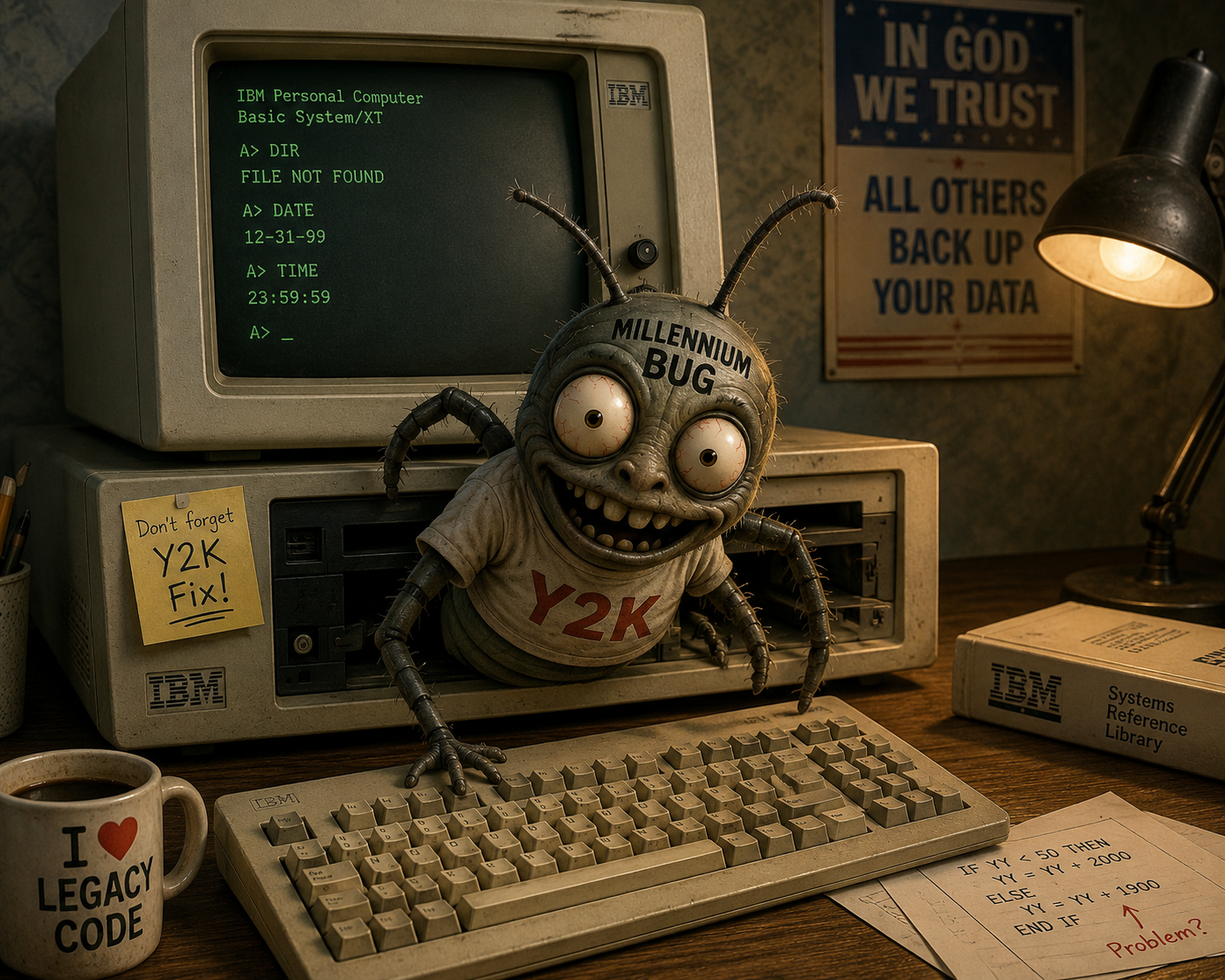
How I Helped the US Marine Corps Survive the Millennium Bug… Sort Of.
There was a great deal of panic as the year 2000 approached.
Aeroplanes were going to fall from the sky. Banks would lose everyone's money. Power stations would stop working. Computers across the world would stare at the date, decide it was 1900 and presumably have some sort of electronic nervous breakdown.
I wasn't particularly worried.
I was making money out of it.
My involvement with the Millennium Bug actually began before anybody asked me to look for one.
During the 1990s, I worked as a computer contractor, which basically meant companies paid me considerably more money than their permanent staff to arrive, look serious and discover what the previous considerably-more-expensive contractor had done wrong.
One contract took me to the East of England, where my job was to investigate some rather poor-quality software written by other contractors and see whether the code could be tightened up.
This involved examining Visual Basic source code.
Lots of it.
And while doing so, something occurred to me.
Visual Basic source code was really just text.
Complicated text, certainly. Text capable of doing clever things. Text which could crash computers, lose data and cause grown men in IT departments to develop interesting facial twitches.
But text nevertheless.
And computers are rather good at searching text.
So instead of spending hour after hour manually searching through somebody else's Visual Basic code looking for questionable programming, why not write a program to do it?
Which is what I did.
I wrote software to investigate software.
Before the program being examined was compiled, my software could search through its source code and identify places where the programming looked suspicious, inefficient or simply capable of being improved.
It didn't necessarily say, "This is wrong."
It said, in effect, "You might want to have a look at this."
For my next trick, I found myself working in Newcastle in the North-East of England.
By then, the approaching year 2000 was becoming rather important.
The problem was beautifully simple.
For years, programmers had often represented years using two digits instead of four. It saved precious storage space in an era when computer memory wasn't something you casually measured in gigabytes.
1998 became 98.
1999 became 99.
Then came 2000.
Or, as far as some software was concerned:
Was that 2000?
Or 1900?
Nobody was entirely certain what every computer program in the world might decide.
That was the Millennium Bug.
And the people in Newcastle wanted me to look for potential Y2K problems in their software.
As luck would have it, I already owned something rather useful.
My software.
All I had to do was refine it so that it could search pre-compiled source code for the sort of date handling that might become troublesome when 31 December 1999 turned into 1 January 2000.
It didn't have to prove there was a problem.
It merely had to point at a piece of code and say:
"That looks a bit suspicious."
A programmer could then examine it and decide whether civilisation was about to collapse.
Or whether somebody had simply written something peculiar in 1987.
The Newcastle contract gave me the opportunity to refine the software further, and then came the interesting bit.
I started selling it.
Companies preparing for Y2K could run their source code through my software and identify areas requiring human attention.
Among the organisations that bought it was the United States Marine Corps.
Yes.
The United States Marine Corps.
Somewhere, presumably, beneath the Stars and Stripes, men considerably fitter than me were using software written by a computer contractor from England to check whether their computers were going to survive the arrival of the twenty-first century.
I have absolutely no idea what they found.
I don't know whether my software discovered a potentially catastrophic date calculation in some vital military system.
I don't know whether it prevented an aircraft from falling out of the sky.
I don't know whether it saved a ship, protected a weapons system or merely discovered that somebody's leave-booking program thought a Marine returning from holiday in January 2000 had been absent without leave for ninety-nine years.
What I do know is that when midnight arrived on 31 December 1999, civilisation continued.
The lights stayed on.
The banks still knew how much money we owed them.
Most importantly, aeroplanes stubbornly refused to fall out of the sky.
And that created an interesting historical problem.
Because Y2K is now often remembered as an enormous fuss about nothing.
Perhaps it was.
But there is another possibility.
Thousands of programmers around the world spent years finding potential problems and fixing them before the clock reached midnight.
Perhaps nothing happened because an enormous number of people had spent an enormous amount of time making sure nothing happened.
Including, in one very small corner of the operation, me.
So did I help the United States Marine Corps survive the Millennium Bug?
Possibly.
Did I save aeroplanes from falling out of the sky?
Almost certainly not.
Did Y2K considerably improve my bank balance?
Definitely.
And, as an added benefit, it saved me from one of those telephone calls from my rather fussy bank manager.
So when people tell me the Millennium Bug was a load of nonsense because nothing happened, I tend to smile.
Nothing happening was rather the point.
And for a brief period at the end of the twentieth century, there was surprisingly good money to be made from making absolutely certain of it.
Copyright © Tom Kane 2026