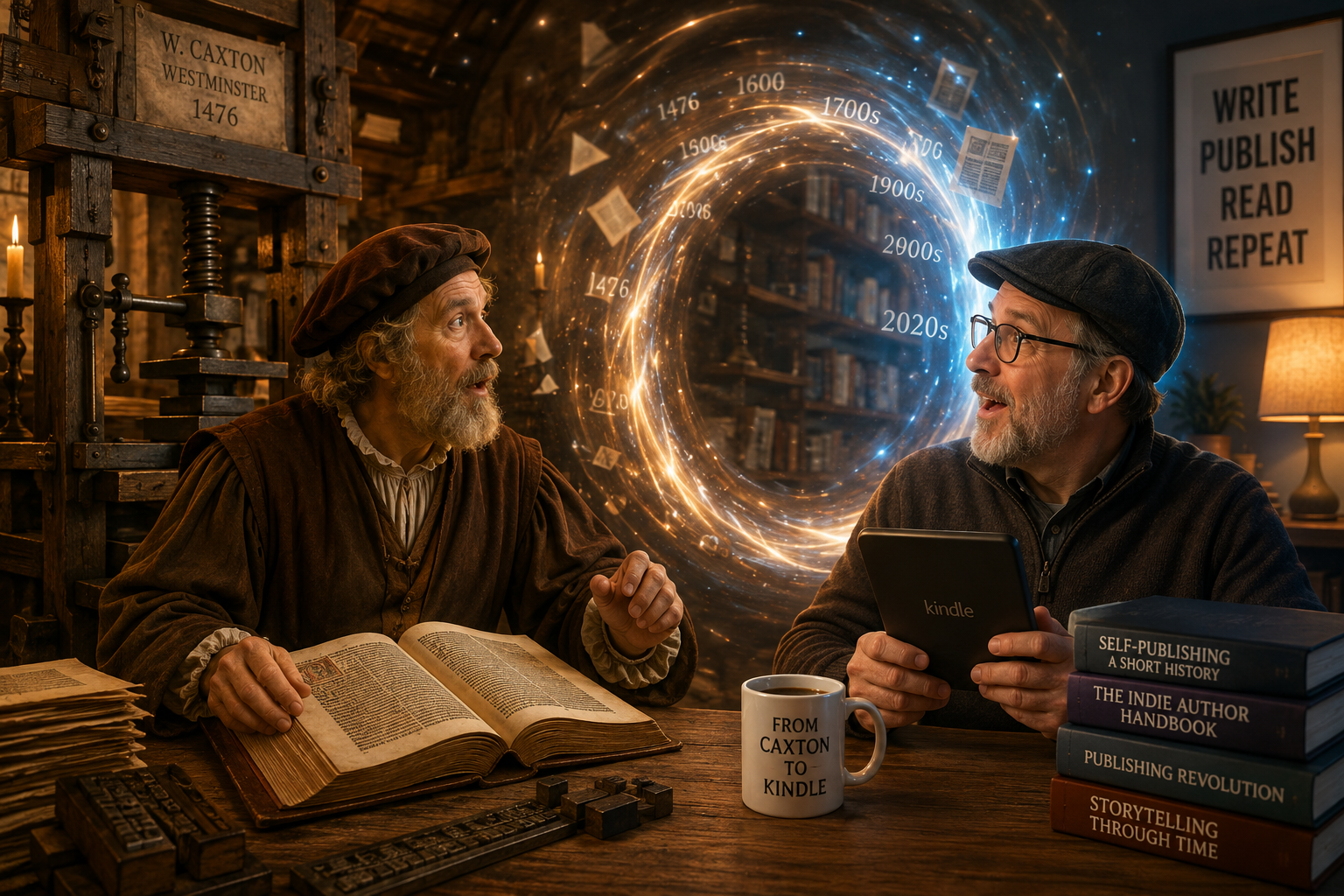
From Caxton to Kindle
Indie Authors Go Back a Long Way
There is a popular belief that independent publishing began sometime around the invention of the Kindle.
Before that, apparently, authors wrote books, handed them reverently to publishers, and waited patiently for somebody in a tweed jacket to decide whether the public deserved to read them.
This is nonsense.
Independent publishing is considerably older than Amazon, considerably older than the internet, and even older than people saying, "Have you tried turning it off and on again?"
In Britain, we can blame William Caxton.
Enter Mr Caxton, carrying something heavy
William Caxton was a merchant, diplomat, writer, translator and, eventually, printer. In the 1470s, he helped introduce printing with movable type to England.
Until then, producing a book was not exactly a quick process.
You couldn't open Microsoft Word, select Save As, upload an ePub and complain because Amazon hadn't approved it within six hours.
Books were copied by hand.
This was excellent news if you happened to be a monk with beautiful handwriting and several spare months. It was less useful if you were an author hoping to reach a large audience before dying of old age.
Then along came the printing press.
Suddenly, one set of words could become many copies.
The publishing revolution had begun.
And, inevitably, somebody had to pay for it.
The original indie publishers
The earliest printers weren't merely operating machines. They were publishers, editors, booksellers, marketers and businessmen rolled into one.
They had to decide what people might want to read.
They had to acquire or create the material.
They had to pay for paper, ink, equipment and labour.
Then, having produced the books, they had to find somebody willing to buy the things.
Does any of this sound familiar?
Five hundred years later, the technology has changed enormously, but the problem hasn't.
You can write the greatest novel in human history, but at some point you still have to persuade somebody to read it.
Caxton couldn't post on Facebook.
He couldn't send a newsletter.
He couldn't offer Book One free for a weekend.
He couldn't check Google Analytics and discover that twelve people had visited his shop but apparently fled before purchasing anything.
He couldn't even blame the algorithm.
Poor man.
Publishing before publishers
The modern publishing house took time to evolve.
Early printers frequently acted as their own publishers and booksellers. Authors could also arrange for works to be printed, sometimes financing the production themselves or finding wealthy patrons prepared to support it.
In other words, authors and printers were experimenting with business models centuries before anyone invented the phrase "self-publishing ecosystem".
Patronage was particularly useful.
Today, an author might use crowdfunding.
Several centuries ago, you found a duke.
The principle was broadly similar, except the duke probably expected a flattering dedication and had considerably more power to remove your head if he didn't like Chapter Seven.
Then came the middlemen
As printing expanded, so did the book trade.
Printers, publishers, booksellers and distributors gradually became separate businesses. Publishing houses grew larger and eventually became the gatekeepers between writers and readers.
For many authors, this worked extremely well.
Publishers provided editing, printing, distribution, marketing and access to bookshops.
The author supplied the words.
Everyone knew their place.
Then the internet arrived and knocked over the furniture.
Suddenly, authors could once again become publishers.
Caxton would understand the Kindle
Imagine explaining an eBook to William Caxton.
"So, William, I have written a novel."
"Excellent. Where is the manuscript?"
"Inside this computer."
"I see. And the printing press?"
"There isn't one."
"The paper?"
"None."
"The ink?"
"Also none."
"How many copies can you produce?"
"As many as people want."
At this point I suspect Caxton would either declare witchcraft or ask where he could buy shares.
Because beneath all the technology, he would recognise the idea immediately.
A writer has something to say.
A method exists for reproducing it.
And somewhere out there is a reader.
Everything between those three things is simply machinery.
The wheel has turned
For several centuries, publishing became increasingly industrialised.
Today, technology has allowed writers to move in the opposite direction.
An independent author can write a book, edit it, create an eBook, arrange a cover, publish it internationally, sell it directly to readers and communicate with those readers without leaving the house.
Which is probably just as well because some of us are still wearing slippers.
We call it indie publishing.
Caxton might simply have called it publishing.
And perhaps that's the amusing part.
After five hundred years of technological progress, enormous publishing corporations, global distribution networks and electronic books capable of appearing on the other side of the world in seconds, authors have somehow arrived back where the whole thing started.
We write the books.
We publish the books.
And increasingly, we sell the books ourselves.
William Caxton would probably approve.
Although somebody would first have to explain the Kindle.
Copyright © Tom Kane 2026