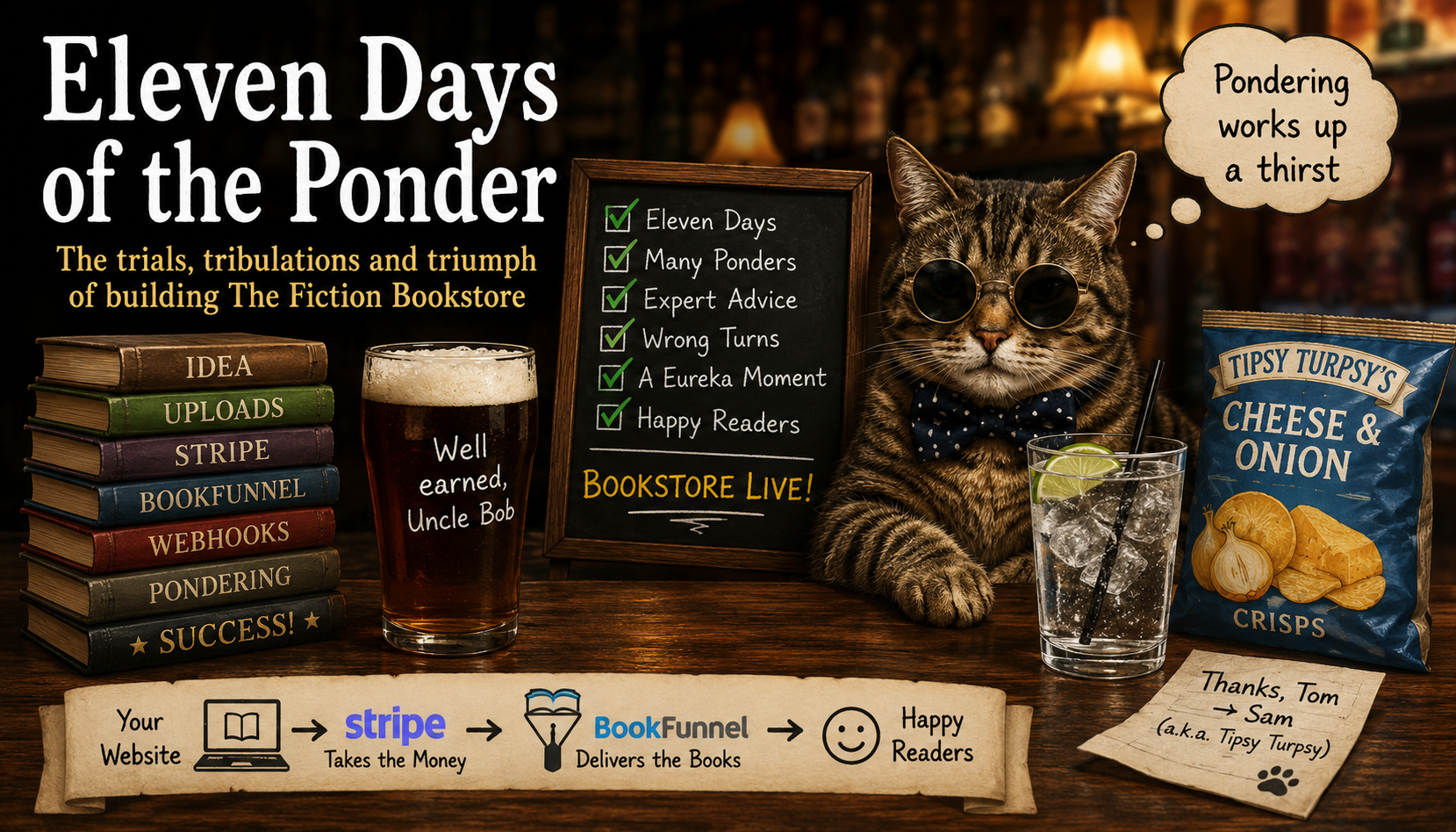
Eleven Days of the Ponder
There is an old saying that Rome wasn't built in a day.
I now know why.
They were probably waiting for technical support.
Eleven days ago, I decided that selling my own books directly to readers would be a good idea. How difficult could it be? I already had a website, I had the books, I had the ePub files and, importantly, I had readers.
All I needed was somewhere to put the books, somewhere to take the money and something to deliver them.
Simple.
Welcome to Eleven Days of the Ponder.
Day One: I Shall Build a Bookstore
The idea was straightforward. I would create The Fiction Bookstore on my website, upload my books and sell them directly.
IONOS provided the eCommerce machinery. Stripe would take the money. Readers would download their books.
And, astonishingly, it worked.
This should have worried me.
Within a few days I had around thirty books uploaded, categorised, priced and decorated with covers, descriptions and all the other bits and pieces a respectable bookstore requires.
I even tested it.
Money went in.
Book came out.
What could possibly go wrong?
Enter BookFunnel
Then I had a thought.
Readers don't necessarily want an ePub file dumped into their Downloads folder. Some know exactly what to do with one. Others stare at it suspiciously as though I've emailed them a component from a washing machine.
BookFunnel solves that problem.
It delivers the book, helps readers get it onto their device and, even better, provides reader support when someone inevitably asks, "I've downloaded it. Where's it gone?"
Wonderful.
All I had to do was connect BookFunnel to Stripe.
And that was when the ponder began.
The Great Triangle
IONOS was connected to Stripe.
Stripe was connected to BookFunnel.
IONOS knew which book had been purchased.
Stripe knew money had changed hands.
BookFunnel knew which Stripe products belonged to which books.
Everybody knew everybody.
Nobody was talking.
Or, occasionally, everybody talked at once and the poor reader was showered with ePubs.
Support tickets were raised.
IONOS offered suggestions.
BookFunnel investigated.
Stripe logs were examined.
Webhooks entered my vocabulary with considerably more frequency than I ever wanted them to.
I removed files, replaced files, bought my own books, gave myself free books, received duplicate emails and spent actual money purchasing things I had written myself.
At one point I knew everything about the transaction except why it didn't work.
The Experts Arrive
Technical support on both sides did their best.
The problem, apparently, was that IONOS was creating the sale while Stripe was merely processing the payment. BookFunnel was waiting for Stripe to tell it that a Stripe checkout had completed.
Stripe wasn't doing that because, from its point of view, it hadn't sold the book.
IONOS had.
This was perfectly logical.
It was also completely useless.
So I pondered.
And pondered.
Then, while wandering around Stripe, I discovered something.
A link.
Just a link.
Stripe could create a payment link for an individual book.
Click it and Stripe opens its own checkout page.
No IONOS eCommerce.
No shopping cart.
No complicated handshaking.
Reader clicks.
Reader pays.
Stripe tells BookFunnel.
BookFunnel delivers.
I tried it.
I bought The Ragged End of Time.
Stripe took my money.
An email arrived confirming payment.
Then another email arrived.
From BookFunnel.
There may have been cheering.
Then I Tried Free
Never celebrate before testing the free books.
Stripe looked at my $0.00 book and essentially said, "That's not shopping."
Fair enough.
For a while I contemplated keeping the IONOS shop alive purely to handle the freebies.
Then came another ponder.
Why?
BookFunnel already delivers free books.
So the final solution turned out to be beautifully simple.
For a paid book:
Website → Stripe → BookFunnel → Reader
For a free book:
Website → BookFunnel → Reader
And IONOS eCommerce?
Retired.
Not deleted. I'm not completely stupid. It's still lurking backstage should I ever need to resurrect it.
But it no longer runs The Fiction Bookstore.
And Then There Was Aunty Flo
One final problem remained.
After paying, Stripe politely told the reader that the payment had succeeded.
It didn't, however, make particularly clear that the actual book was about to arrive by email from BookFunnel.
I imagined poor old Aunty Flo sitting in front of her computer.
"I've paid him. Where's my bloody book?"
So Stripe now carries a short message explaining that books are delivered by BookFunnel email.
Aunty Flo can relax.
And so can I.
Eleven Days Later
The button has been pressed.
The new system is live.
Paid books go through Stripe. Free books go directly through BookFunnel. BookFunnel delivers the books and helps readers get them onto Kindle, Kobo, Nook, Google Play Books or simply download the ePub. Readers can even read in a browser or use BookFunnel's own reading system.
Better still, if somebody can't work out how to get the book onto their device, BookFunnel provides the reader support.
Which means they don't have to ask me.
This alone may be worth the entire eleven days.
There is probably a profound lesson here about software architecture, integration and keeping systems simple.
There is definitely a less profound one.
Sometimes, after eleven days of listening to experts explain why something doesn't work, the solution is to find a link nobody mentioned and route around the problem.
The Fiction Bookstore is open.
The books are ready.
Stripe has the till.
BookFunnel has the warehouse.
And I am going down the pub.
Apparently Uncle Bob is already there.
He's buying.
Cheers.
Copyright © Tom Kane 2026