Don't Mix Your Googly with Your Googol
Google Analytics is like watching a spinning ball. Mind-numbing, but strangely addictive.
There was a time when running a bookshop was simple.
A customer walked through the door.
You could see them.
If they picked up a book, you could see that too.
If they put it back down again and walked out, you resisted the temptation to chase them down the street shouting, "WHAT WAS WRONG WITH IT?"
The internet has improved all this.
Now you don't know who came into the shop, why they came into the shop or whether they were ever actually in the shop.
But Google has a graph.
I recently connected Google Analytics to The Fiction Bookstore.
This was a mistake.
I now know things I didn't previously know that I didn't know.
Apparently I have users.
I have active users.
I have new users.
I have returning users.
I have events.
I have sessions.
I have engaged sessions.
And occasionally I have something called a bounce.
A bounce, as far as I can determine, means somebody came into my bookshop, looked around and left again.
In retail we used to call this "a customer".
Google has improved upon the terminology.
Then there is Google Search Console.
Do not confuse Google Search Console with Google Analytics.
Analytics tells you what people did after they arrived.
Search Console tells you why they didn't arrive in the first place.
I think.
Google Search Console recently informed me that my website had appeared in Google searches more than a thousand times.
Wonderful.
Two people clicked.
Less wonderful.
So I investigated.
It turned out Google had developed some interesting ideas about my business.
I sell fiction books. Historical fiction. Science fiction. Noir. Thrillers.
Google had apparently decided I might also be useful to people wanting to know how to keep flies away.
This was unexpected.
I checked my catalogue.
Nope, I have definitely not written The Perfect Flyswatter.
Google, I decided, had finally lost its marbles. Why on earth would anybody searching for ways to get rid of flies be directed towards Tom Kane, an author of historical fiction, science fiction and noir?
And yet.... I did a search... and I laughed.
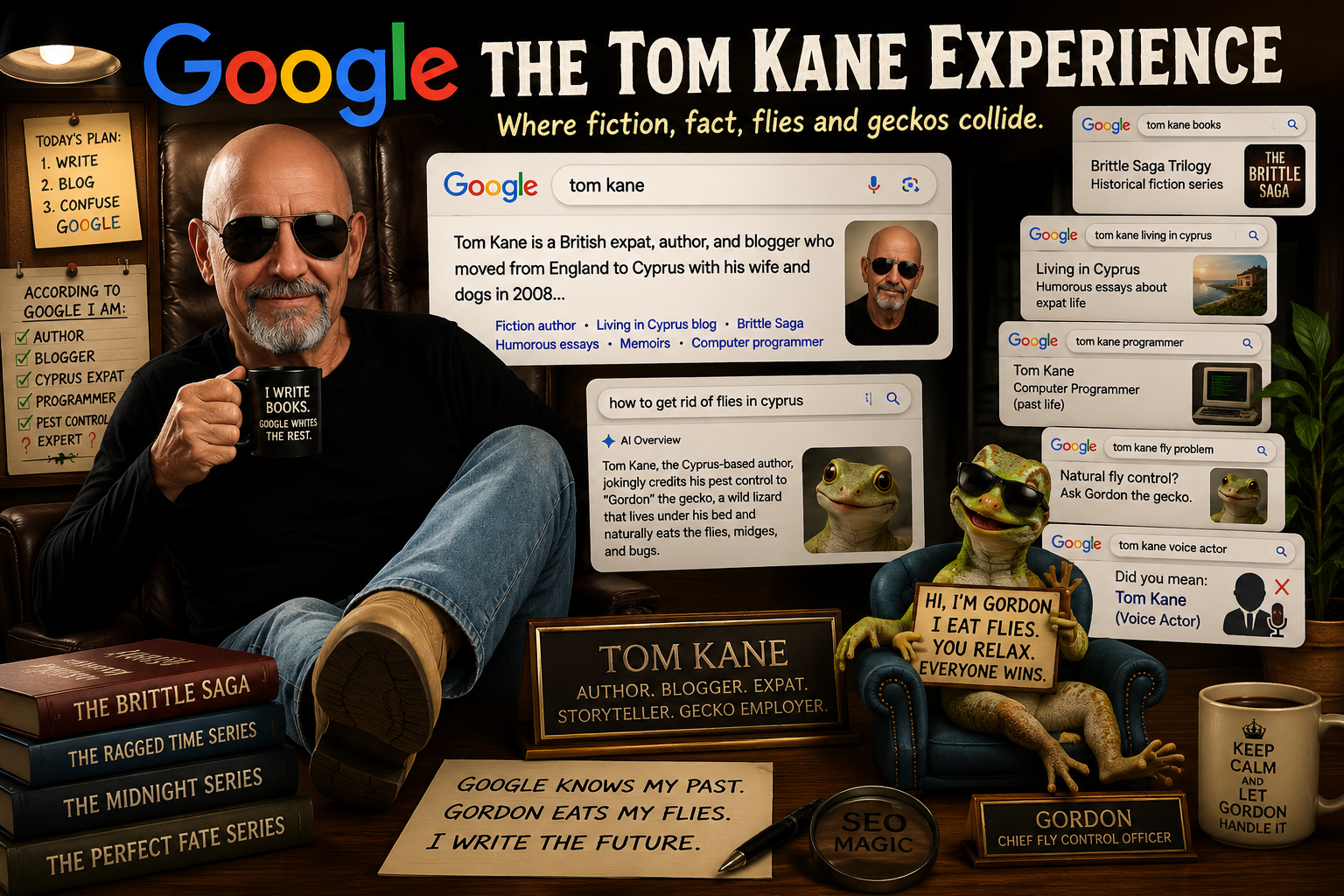
Apparently, years ago, I wrote about Gordon. Gordon was a gecko who lived under my bed in Cyprus and earned his keep by eating flies, midges and assorted airborne nuisances.
Google remembered Gordon.
I didn't.
Is this the future, the disturbing moment in everyones life when they discover Google knows more about their past than they know themselves. Worse still, Google had the receipts.
So I owe Google Search Console an apology.
Those people weren't being mistakenly sent to an author when they searched for ways to keep flies away.
They were looking for an expert.
Apparently, that's me. Although in fairness, Gordon did most of the work.
This is the point at which Analytics becomes strangely addictive.
You stare at numbers. You change the date. The numbers change. You click another button.
A graph appears.
You don't understand the graph, so you click something else.
The screen goes white. A little ball begins spinning.
You wait. And wait.
Eventually Google presents another graph containing precisely the information you didn't know you weren't looking for.
Writers understand this process.
It is remarkably similar to editing a novel.
You change one sentence.
That affects the paragraph.
You change the paragraph.
That affects the chapter.
Three hours later you've rewritten Chapter Seven and can no longer remember what was wrong with the original sentence.
Google Analytics works exactly the same way, except there are more graphs.
My favourite discovery this week was that seven active users apparently managed to generate 238 views of my shop.
Either Google is counting something peculiar, or I have attracted seven extraordinarily indecisive readers.
"Shall I buy it?"
"I don't know."
"Let's look again."
Thirty-four visits later...
"No. Still not sure."
There is, however, a serious point buried underneath all this statistical nonsense.
People are coming to my bookstore. They're staying. They're looking around.
Some arrive from Facebook, Twitter, BlueSky and some arrive directly. Eventually, presumably, Google itself will work out that I sell books rather than insect-control equipment.
And occasionally, I hope, somebody buys something.
That, when you strip away the graphs, sessions, events, engagement rates and spinning balls, what matters is the website is really just a shop.
You put something interesting in the window.
People stop. Some come inside. Some browse. They leave.
Some come back another day.
And eventually somebody reaches for their wallet.
Retailers have understood that for centuries.
Google merely found a way of putting it on a graph.
Now, if you'll excuse me, there's a little ball spinning on my screen.
Something important might be happening.
Or Google may have found another fly. Where's Gordon when you need him?
Copyright © Tom Kane 2026