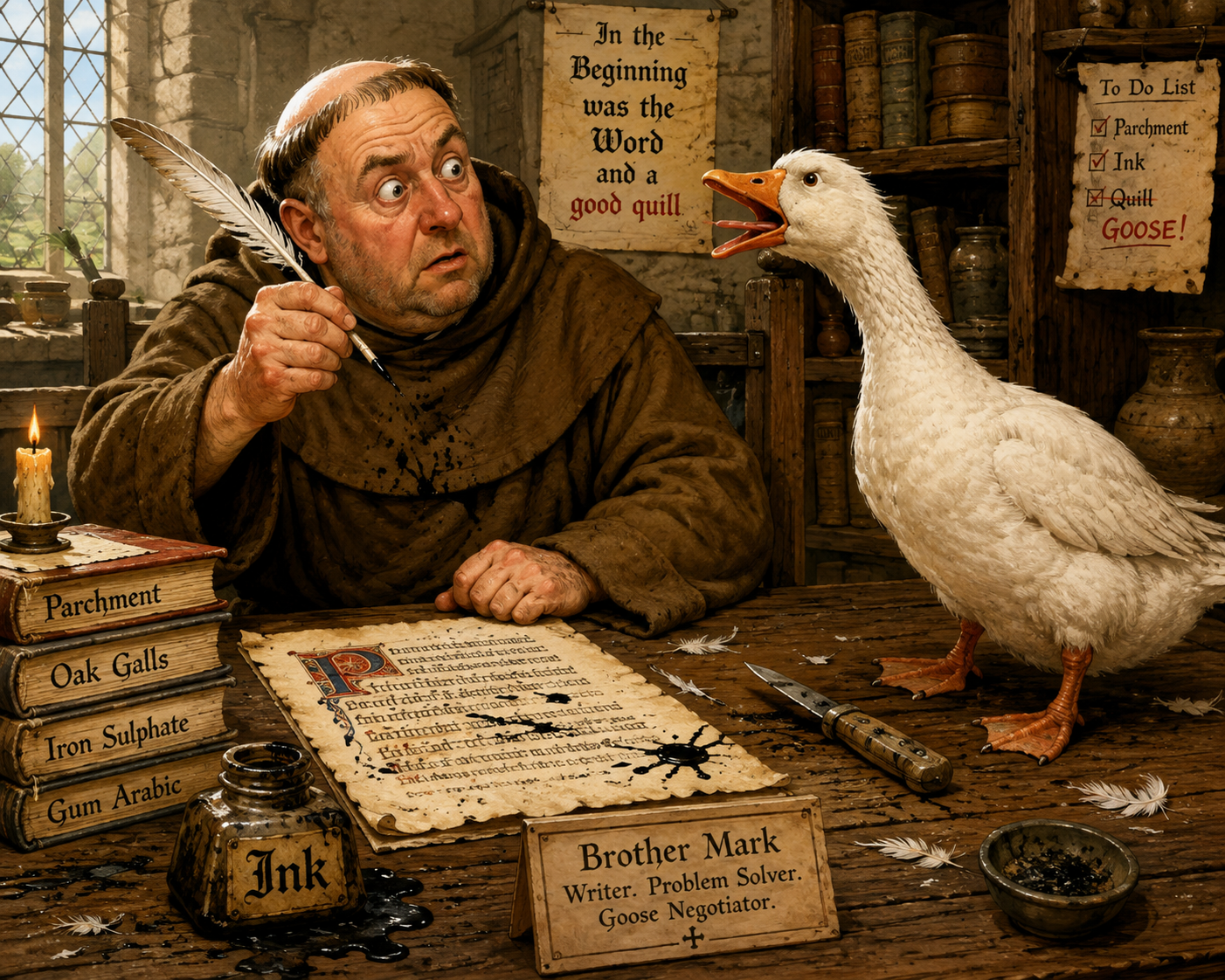
Brother Mark's Writing Day
Poor Brother Mark was having one of those days.
The important book lay open on the wooden desk before him, 286 pages of painstaking work that had taken the better part of a year to copy by hand. Every letter sat obediently beside its neighbour. Every flourish had been carefully judged. Every illuminated capital had been painted with the patience of a saint.
Which was fortunate, because Brother Mark wasn't feeling particularly saintly.
Only one page remained. Just one page.
The abbot had already promised the finished manuscript to a neighbouring monastery, where it would be copied all over again by another unfortunate monk who would probably develop exactly the same expression Brother Mark currently wore.
Then disaster struck. The parchment buckled. Not dramatically. It simply chose that precise moment to remind him it had once belonged to a sheep.
Brother Mark sighed.
Parchment wasn't paper. Paper was centuries away from becoming commonplace in Europe. This was carefully scraped and stretched animal skin that had taken days to prepare, and today's piece had apparently decided it preferred being wrinkled.
Brother mark flattened it. It wrinkled again. He flattened it harder. It remained unconvinced.
"Very well," he muttered. "We'll both be stubborn."
That crisis temporarily subdued, he reached for his ink. Or rather, what remained of it. His ink had thickened overnight.
Medieval ink wasn't bought in convenient little bottles with reassuring labels and expiry dates. Much of it was made in-house from oak galls, iron salts and gum arabic. The mixture produced wonderfully durable black writing, but it also possessed a personality.
Today's personality was treacle. Brother Mark added a little water. The ink became watery treacle.
Close enough, he thought and dipped his quill.
Scratch.
Scratch.
Scratch.
Halfway through an elegant capital letter W the quill cracked and snapped.
Brother Mark stared at it in disbelief. "You had one job to do!"
Silence. The quill refused to apologise.
There was only one solution.
A goose.
Monasteries rarely suffered a shortage of geese. They supplied feathers, eggs, noise and an extraordinary ability to object to almost everything. Brother Mark walked into the monastery yard with what looked suspiciously like determination. The geese recognised that expression and scattered.
One particularly large goose, clearly the union representative, stood its ground. Brother Mark approached cautiously.
The goose hissed.
Brother Mark hissed back.
Neither side considered this especially mature.
Eventually the goose lost.
Not completely, of course. Brother Mark only needed one large flight feather from the left wing, which naturally curved away from the hand when held by a right-handed writer. The goose retained its dignity, although it expressed strong opinions about the matter for several minutes afterwards.
Back in the scriptorium, Brother Mark prepared the feather. A fresh quill wasn't immediately ready for writing. The shaft had to be hardened before the nib could be carefully cut with a small knife.
The penknife was born from the need for a monk to write. Quills did not come ready cut. Brother mark had to trim, cut, test and trim again until the quill was perfect.
He returned to the manuscript.
Scratch.
Scratch.
Scratch.
The new quill glided beautifully across the parchment as though none of the morning's catastrophes had ever happened.
By sunset, Brother Mark wrote the final word.
He placed the quill beside the completed manuscript and leaned back with enormous satisfaction.
A year's work.
Finished.
The abbot entered, smiling warmly.
"Excellent work, Brother Mark."
"Thank you, Father."
"We'll need another copy."
Brother Mark slowly looked towards the monastery yard.
The geese looked back.
One of them began running.
The Moral of the Story
People sometimes imagine medieval books simply appeared as if by magic.
In reality, every manuscript represented an extraordinary chain of craftsmanship. Someone prepared the parchment. Someone made the ink. Someone sacrificed a goose's finest flight feather. Someone bound the finished pages. And somewhere in the middle sat a monk patiently writing every single word by hand.
Modern writers have different problems. Our quills are called keyboards. Our parchment is called a screen. Our ink is measured in battery percentage. And instead of chasing geese around a monastery yard, we spend our afternoons arguing with formatting software.
And as an indie author, don't even get me started on marketing.
I'm not entirely convinced we've made life simpler.
Copyright © Tom Kane 2026