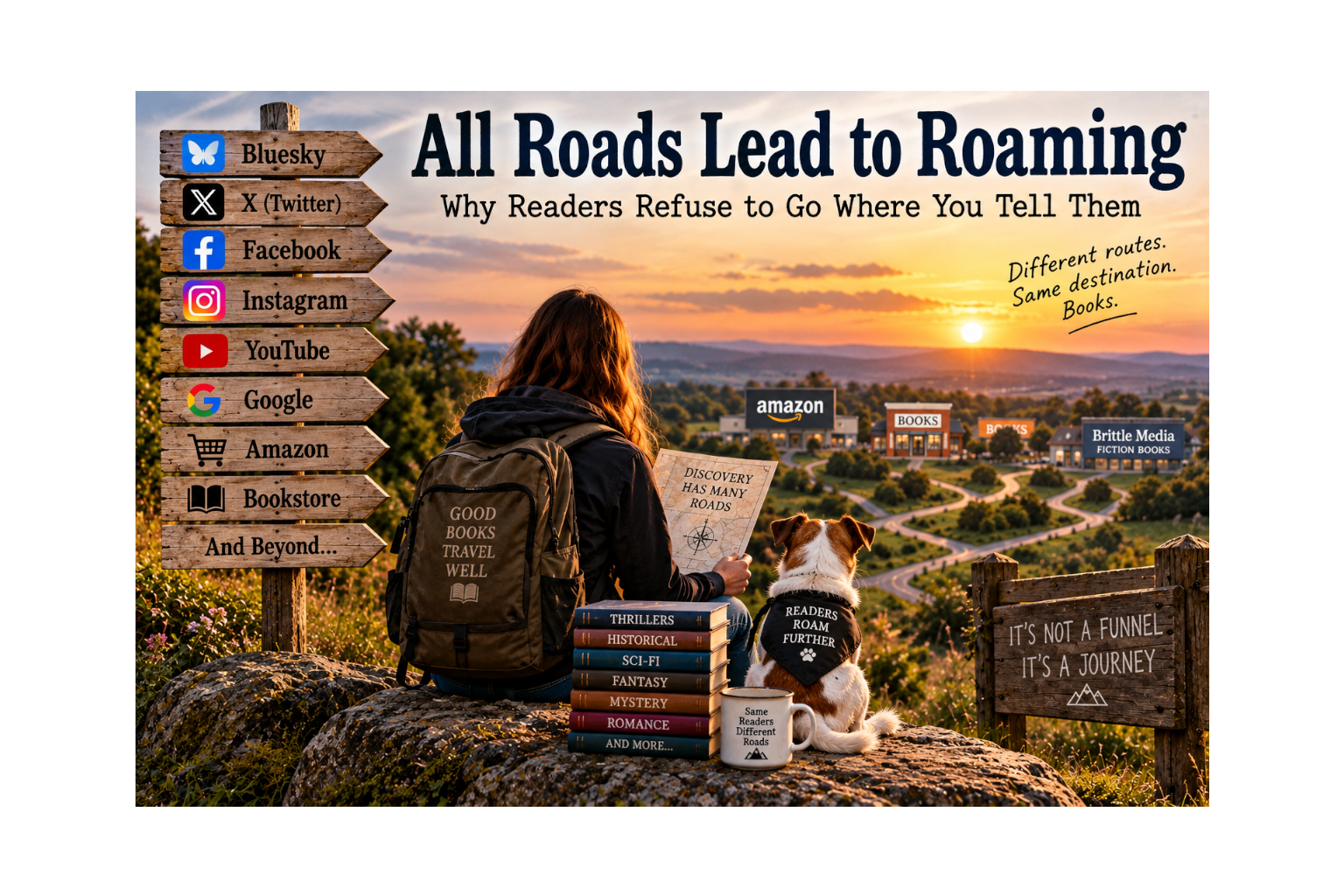
All Roads Lead to Roaming
Or: Why Readers Refuse to Go Where You Tell Them
There is something wonderfully reassuring about marketing theory.
You place an advert on social media.
A reader sees it. The reader clicks the link. They arrive at your website. They buy the book.
You examine your statistics, stroke your chin thoughtfully and announce that your marketing campaign has been a success.
There is only one slight problem. Readers don't appear to have read the marketing theory.
I recently conducted a small experiment with one of my books, The Perfect Act.
Nothing terribly scientific. I advertised the same book across five different social-media platforms and gave each advert its own unique, trackable link.
Why? Well, the idea was simple. If somebody clicked an advert on Facebook, I would know. If somebody came from Bluesky, I would know. The same applied to the other platforms.
For once, I would be able to see exactly where my readers were coming from.
Then I waited.
And waited.
Almost nothing happened.
Only one social-media platform produced identifiable clicks: Bluesky.
At this point, conventional marketing wisdom might suggest that I should retire to a darkened room and reconsider my life choices.
Except something else happened.
Books sold.
Not The Perfect Act, either.
Two other books in the same series sold on Amazon: The Perfect Crime and The Perfect Fate of η = 1.
That was interesting.
What made it considerably more interesting was that both books cost $1.99 on Amazon.
They were cheaper at my own bookstore.
In fact, The Perfect Fate of η = 1 was available there free.
Somebody apparently preferred paying Amazon $1.99 for a book they could have downloaded from me for nothing.
Welcome to indie publishing.
The Funnel Has Sprung a Leak
For years we've been encouraged to think in terms of funnels.
Someone sees an advert at the wide end. A percentage click. Some of those investigate. A smaller number buy.
Advert → Website → Product → Purchase.
Lovely.
Unfortunately, human beings have an irritating habit of wandering off.
Perhaps someone sees an advert for one of my books on Facebook while waiting for the kettle to boil.
They don't click it.
Later they remember the author's name and search Amazon. Perhaps they Google the title. Perhaps they encounter another book entirely. Perhaps they visit my website, wander through a series page, leave, come back tomorrow and eventually buy something from their favourite retailer. Perhaps they do something I haven't even thought of.
From my point of view, the original advert produced precisely nothing.
From the reader's point of view, it may have started the entire journey.
Readers Roam
This led me to wonder whether the traditional funnel is the wrong shape for books.
Buying fiction isn't necessarily like buying a replacement toaster.
Readers browse.
They investigate authors.
They look at covers.
They read blurbs.
They check Amazon.
They look at reviews.
They disappear.
They come back.
They discover another title.
They download something free.
And sometimes they pay $1.99 for something they could have had for nothing.
Perhaps there isn't a funnel at all.
Perhaps there are simply roads.
Amazon is one road.
An author's website is another.
Google is another.
Facebook, Bluesky and the rest are roads.
Blogs are roads.
Recommendations are roads.
Free stories are roads.
And readers roam between them.
Which Raises an Awkward Question
How much advertising that apparently "doesn't work" actually works?
If I advertise Book A on Facebook and somebody subsequently searches Amazon and buys Book C, Facebook records no click.
My tracking link records nothing.
Amazon records a sale.
Every individual system is telling the truth.
But none of them knows the whole story.
That matters to indie authors because we can very easily make decisions based upon the bit we can measure.
"No clicks. Stop advertising there."
"No direct sales. The website doesn't work."
"People aren't buying from my bookstore. Close it."
Maybe.
But perhaps the website introduced them to the books.
Perhaps the advert introduced them to the author.
Perhaps the free story introduced them to the publisher.
And Amazon merely happened to be where they finally opened their wallet.
So I'm Going to Keep Roaming
I'm going to conduct a few more experiments.
Not because I expect to discover the Great Secret of Book Marketing. Anyone claiming to possess that probably has a course they'd like to sell you.
I simply want to understand a little better how readers discover books.
The next experiment will involve another book.
Another will involve an article.
And another will involve a completely different piece of fiction with virtually no conventional book marketing attached to it at all.
Then I'll watch what happens.
Perhaps nothing will.
That's the joy of experiments.
But I'm beginning to suspect that when it comes to discovering books, readers don't follow funnels.
They roam.
And perhaps our job isn't to force them down one particular road.
It's simply to make sure that whichever road they choose…
there's a book waiting at the end of it.
Copyright © Brittle Media Ltd 2026